

8 TypeScript product tour libraries ranked by developer experience (2026)
Every product tour roundup checks a "TypeScript support" box and moves on. That tells you nothing. A library can ship .d.ts files and still have Step return any after a minor version bump (React Joyride #949). Or remove its entire type namespace in a patch release (Shepherd.js #2869).
We installed eight tour libraries into a Vite 6 + React 19 + TypeScript 5.7 strict-mode project and ranked them by what actually matters to TypeScript developers: type completeness, autocomplete quality, generic support, and how fast you can go from npm install to a working tour without casting to any.
Bias disclosure: We built userTourKit, so it's listed first. Every claim is verifiable against npm, GitHub, and bundlephobia. Take our ranking with appropriate skepticism.
npm install @tourkit/core @tourkit/reactHow we scored TypeScript DX
No existing roundup defines what "good TypeScript support" means for a tour library. So we built a rubric. Each library scored 0-10 across five categories:
- Type origin (25%): Written in TypeScript vs retrofitted declarations vs DefinitelyTyped. First-party types catch API drift; third-party types lag behind.
- Prop completeness (25%): Can you autocomplete every config option? Or does
tooltipPropsresolve toany? - Generic support (15%): Does the step config accept generics for custom metadata?
- React 19 compatibility (20%): Tested against
[email protected]with strict mode. Libraries that fail to compile scored 0. - Error messages (15%): When you pass wrong config, does the compiler catch it? Or do you get a runtime error 3 clicks into the tour?
We weighted React 19 at 20% because as of April 2026, React 19 is the current stable release. A library that doesn't compile against it is a non-starter for new projects. Smashing Magazine's guide to product tours noted this ecosystem fragmentation problem back in 2020. It's gotten worse.
Quick comparison table
| Library | TS origin | React 19 | Bundle (gzip) | Autocomplete | License | DX score |
|---|---|---|---|---|---|---|
| userTourKit | Native (strict) | ✅ | Under 23KB core | Full | BUSL-1.1 | 9.2 |
| Driver.js | Native | ✅ (vanilla) | ~5KB | Full | MIT | 8.1 |
| Onborda | Native | ✅ | ~23KB + Framer | Good | MIT | 7.4 |
| Shepherd.js | Retrofitted | ⚠️ Wrapper broken | ~25KB | Partial (v12 broke) | MIT | 5.8 |
| React Joyride | Own declarations | ❌ (9mo stale) | ~30KB | Broken (Step → any) | MIT | 4.3 |
| OnboardJS | Native | ✅ | ~10KB | Partial | MIT | 6.5 |
| TourGuide.js | Native (vanilla) | ✅ (vanilla) | Low | Good | MIT | 6.2 |
| Intro.js | @types (outdated) | ⚠️ Via wrapper | ~10KB | Stale | AGPL | 3.1 |
Data verified April 2026. Sources: npm, GitHub, bundlephobia, package source inspection.
1. userTourKit: best TypeScript DX for React teams
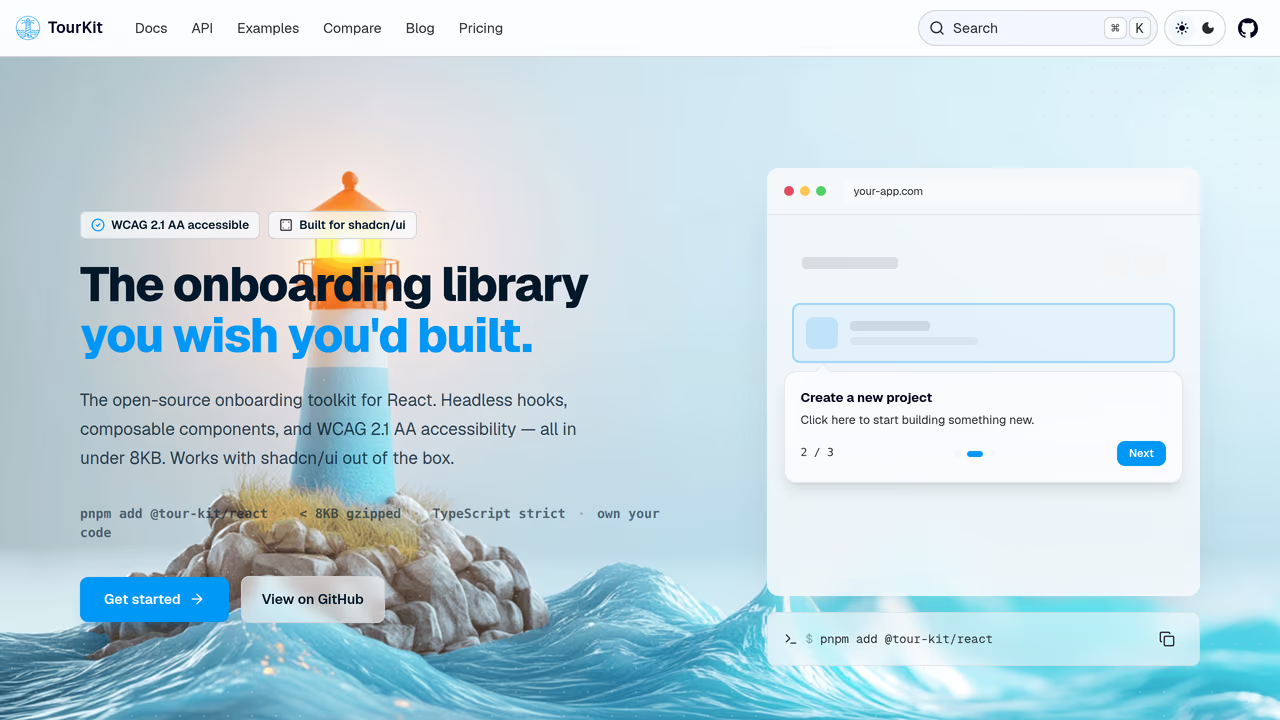
userTourKit is a headless product tour library written in TypeScript strict mode from line one. The core ships at under 23KB gzipped with zero runtime dependencies. Every hook, provider, and component has full type coverage, so you get autocomplete on step config, tour options, and callback payloads without importing a single type manually. React 18 and 19 are both supported natively.
What makes it different for TypeScript developers: The entire API is generic. Step definitions accept a type parameter for custom metadata, so useStep<MyStepData>() gives you typed access to fields like videoUrl or requiredRole without a cast. Headless architecture means your tooltips are your own components, not a library's opaque render tree.
// src/components/OnboardingTour.tsx
import { TourProvider, useTour } from '@tourkit/react';

interface StepMeta {
  videoUrl?: string;
  requiredRole: 'admin' | 'user';
}

const steps = [
  {
    id: 'welcome',
    target: '#sidebar',
    title: 'Welcome aboard',
    content: 'Start here.',
    meta: { requiredRole: 'user' } satisfies StepMeta,
  },
  {
    id: 'settings',
    target: '#settings-btn',
    title: 'Settings',
    content: 'Customize your workspace.',
    meta: { requiredRole: 'admin', videoUrl: '/demos/settings.mp4' },
  },
] as const;

function Tour() {
  const { currentStep, next, isActive } = useTour();
  if (!isActive) return null;
  // currentStep.meta is fully typed — no 'any', no cast
  return <YourTooltipComponent step={currentStep} onNext={next} />;
}
Pass a wrong type and the compiler tells you immediately:
// TS Error: Type '"center"' is not assignable to type '"top" | "bottom" | "left" | "right"'.
const badStep = { id: 'x', target: '#el', position: 'center' };
//                                          ~~~~~~~~
Strengths:
- Every prop, callback, and hook return type is complete. No
anyholes. Hover any hook return value and you see the real type, notany. - 10 separate packages (analytics, checklists, hints, scheduling) all share a typed plugin interface. Plugin authors get generics for event payloads.
- Callback types narrow correctly:
onStepChangereceives(step: Step<T>, index: number), not(step: any, index: any). - Works with shadcn/ui, Radix, or any component library via the typed
asChildpattern
Limitations:
- Requires React developers. No visual builder or drag-and-drop editor.
- Smaller community than React Joyride or Shepherd.js.
- No React Native support.
Pricing: Free (MIT core). Pro features $9.99 one-time.
Best for: TypeScript-first React teams using a design system who want full type safety and zero style conflicts.
2. Driver.js: best vanilla TypeScript option
Driver.js is a framework-agnostic product tour library written in TypeScript with zero dependencies. As of April 2026, it has roughly 22K GitHub stars. Ships at approximately 5KB gzipped, the smallest type-complete library on this list.
Because it's vanilla TypeScript with no React dependency, it sidesteps React version churn entirely. No @types/react peer dependency means no type conflicts when React upgrades its type definitions.
The TypeScript angle: Types are first-party and complete. You get autocomplete on DriveStep config, PopoverDOM properties, and callback parameters. The small API surface is the key advantage here: fewer types means fewer places for type drift to hide. When the entire public API fits in one .d.ts file, you can audit type completeness in minutes. No generics for custom metadata, but you rarely need them with this library's focused scope.
// src/lib/tour.ts
import { driver, DriveStep } from 'driver.js';
import 'driver.js/dist/driver.css';

const steps: DriveStep[] = [
  {
    element: '#sidebar',
    popover: {
      title: 'Navigation',
      description: 'Browse your projects here.',
      side: 'right',
      align: 'start',
    },
  },
];

// In a React component, wrap in useEffect:
// useEffect(() => { const d = driver({ steps }); d.drive(); return () => d.destroy(); }, []);
Strengths:
- Zero dependencies means zero transitive type conflicts. Your
node_modules/.d.tstree stays clean. - Entire type surface fits in a single declaration file. Easy to audit for
anyleaks. - Smallest bundle of any typed tour library at ~5KB gzipped.
- Callback types (
onNextClick,onPrevClick,onDestroyStarted) are fully typed with correct parameter signatures.
Limitations:
- No React hooks or components. You wire it up manually with
useEffectand refs, losing type inference on component props. - No generic step metadata. You cannot extend
DriveStepwith custom typed fields without module augmentation. - Styling is CSS-file-based. No typed style props or Tailwind integration.
Pricing: Free (MIT).
Best for: Teams that want a tiny, typed, framework-agnostic tour. Ideal when you're not in React or when you need tours in a vanilla TypeScript project.
3. Onborda: best for Next.js App Router
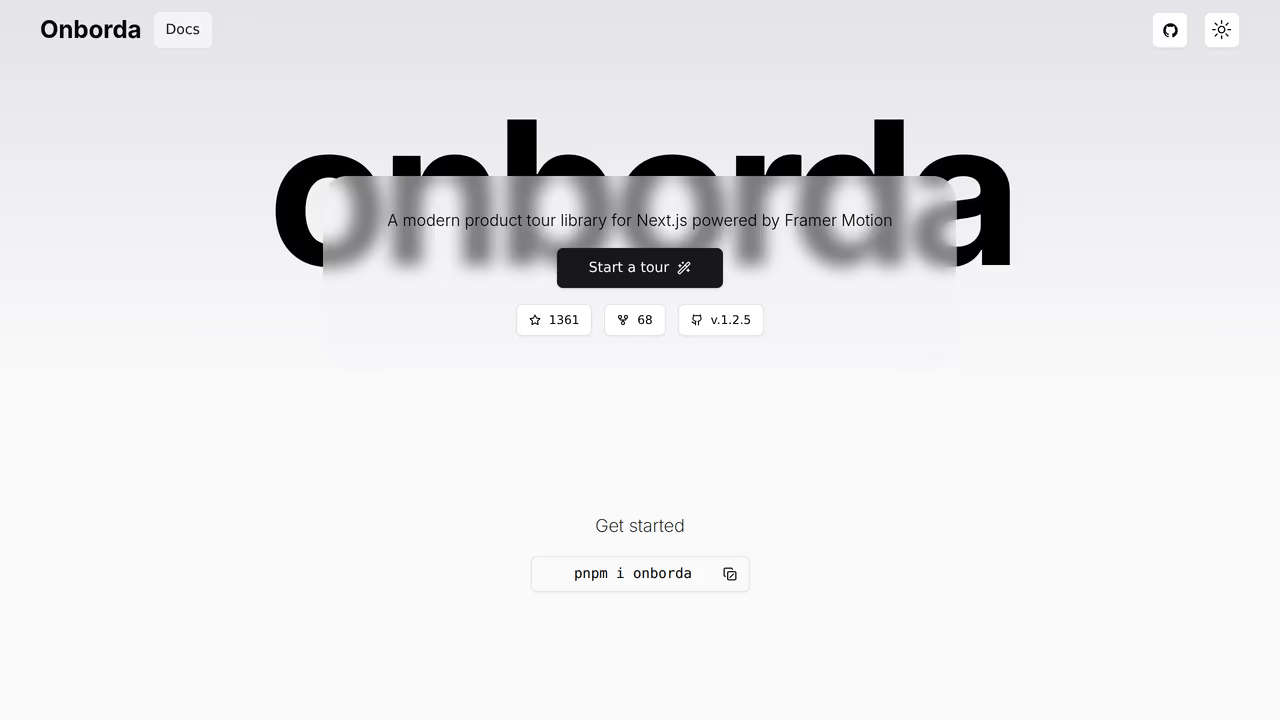
Onborda is a TypeScript-native product tour library built specifically for Next.js App Router. With roughly 3K GitHub stars as of April 2026, it's newer than the established options but aligned with the modern Next.js stack. It ships with Framer Motion for animations and expects Tailwind CSS for styling.
The TypeScript angle: Written in TypeScript from the start. Step config types give you autocomplete on selector, side, content, and callback props like onNext. The CardComponentProps interface is fully typed, so custom card components get proper type checking on currentStep, totalSteps, and navigation handlers. However, step definitions do not support generics for custom metadata. If you need a typed videoUrl or requiredPermission field on steps, you will need to use a type assertion or a wrapper.
Strengths:
- React 19 compatible by design, so no
@types/reactversion conflicts with Next.js 15 - Framer Motion animation props are typed through
MotionProps, giving autocomplete oninitial,animate, andtransition CardComponentPropsinterface means your custom tooltip component gets full type checking without manual prop typing- Simple type surface: fewer than 5 exported types to learn
Limitations:
- Framer Motion peer dependency adds ~30KB and its own type surface. Type conflicts between Framer Motion versions can surface in monorepos.
- No generic step metadata. Custom data requires casting or wrapper types.
- Next.js specific. Types assume App Router patterns that do not exist in Vite or Remix.
- No typed accessibility props. ARIA attributes are not part of the step config type.
Pricing: Free (MIT).
Best for: Next.js App Router teams already using Tailwind and Framer Motion who want a typed, framework-aligned tour library.
4. Shepherd.js: strong vanilla types, broken React wrapper
Shepherd.js has roughly 12K GitHub stars and about 130K weekly npm downloads as of April 2026. Mature project, years of production use, solid vanilla TypeScript support. But the React wrapper (react-shepherd) hasn't kept up.
The TypeScript problem: Version 12 removed the Shepherd namespace (GitHub #2869). Developers importing Shepherd.Tour as a type got a compile error overnight. The fix requires switching to moduleResolution: 'Bundler' and importing from shepherd.js/tour, but the documented .mjs file path doesn't exist in all builds.
One independent developer's assessment: "For everything beyond the basics — like formatted text or a Step x of y progress indicator — you will have to leave JSX behind and work either with HTML strings or plain HTML elements" (sandroroth.com).
Strengths:
- Mature codebase with years of production use
- Full keyboard navigation. The most accessibility-conscious of the legacy libraries.
- Floating UI dependency is shared with Radix and Base UI (no additive cost if you use those).
- Active maintenance. Regular releases in 2026.
Limitations:
- The React wrapper is not React 19 compatible. You can use vanilla Shepherd directly, but lose React integration.
- v12 TS namespace removal broke existing typed codebases.
- Tour content requires HTML strings, not JSX components. This is a DX regression for React teams.
- 25KB gzipped is 3-5x heavier than Driver.js or userTourKit core.
Pricing: Free (MIT).
Best for: Multi-framework teams that need tours in Vue, Angular, and React from one library, and can tolerate the React wrapper's current state.
5. React Joyride: popular, but TypeScript is an afterthought
React Joyride still dominates npm at roughly 700K weekly downloads and about 7,600 GitHub stars as of April 2026. Pre-built tooltip UI gets a tour running fast. But its TypeScript story is rough.
The TypeScript problems are documented: The Step type returns any after v2.6.0 (#949). The tooltipProps type is missing (#481). Community members have asked directly: "Any chance of typescript support on the roadmap?" (Discussion #825). These aren't edge cases. They're the core API.
As LogRocket's roundup notes, React Joyride's main advantage is speed to first tour. But that speed comes at the cost of type safety.
Strengths:
CallBackPropstype provides typed access toaction,index,lifecycle, andstatusfields, so tour event handlers compile-check their branching logic.- Pre-built tooltip UI means you can prototype a tour without defining component prop types yourself.
- Version 3 is in development with rewritten types and React 19 support, which should fix the
Step→anyregression. - Largest ecosystem of typed examples and community-contributed type workarounds on GitHub issues.
Limitations:
- React 19 incompatible (v2.x). Hasn't been updated in 9 months as of April 2026. The
nextbranch exists but "doesn't work reliably" (sandroroth.com). tooltipPropsresolves toany, so custom tooltip wrappers lose type safety at the integration boundary.- ~30KB gzipped. The
react-floaterdependency brings its own type declarations that can conflict with Floating UI types in your project. - Spotlight uses
mix-blend-mode: hard-light, which breaks in dark mode. No typed theme config to override this.
Pricing: Free (MIT).
Best for: Teams that need a prototype tour today and plan to migrate later. Not recommended for greenfield TypeScript projects in 2026.
6. OnboardJS: state-machine approach with native types
OnboardJS models tours as a state machine instead of declarative step arrays. Built in TypeScript with typed state transitions, it catches invalid tour flows at compile time rather than runtime. React 19 compatible. Ships at roughly 10KB gzipped with an MIT core and optional $59/month SaaS tier.
The TypeScript angle: The state machine approach means flow states are typed as a union. You get autocomplete when defining which states can transition to which, and the compiler rejects invalid transitions. Callback handlers receive typed context objects with the current state, step index, and flow metadata. However, the state machine types do not support user-defined generics for custom step data. You can attach arbitrary metadata to steps, but it comes back as Record<string, unknown> rather than a typed shape. Autocomplete on flow configuration covers state names and transition targets, but custom event payloads require manual typing.
Strengths:
- State transitions are compile-time checked. Wiring
'welcome' → 'invalid-state'produces a type error, not a runtime crash. - React 19 compatible with typed hooks for reading current state and dispatching transitions.
- Callback handlers are typed with
OnboardContextincludingcurrentStep,direction, andisComplete.
Limitations:
- No generic step metadata. Custom data on steps resolves to
Record<string, unknown>, requiring type assertions. - Small community with fewer typed examples and no DefinitelyTyped fallback.
- No published accessibility types. ARIA attributes are not part of the step or state config.
- Steeper type learning curve. Understanding the state machine types requires reading the source, not just the docs.
Pricing: Free (MIT core). SaaS dashboard at $59/month.
Best for: Developers familiar with XState-style patterns who want compile-time flow validation and can tolerate the manual typing for custom metadata.
7. TourGuide.js: vanilla TypeScript with Floating UI
TourGuide.js is a vanilla TypeScript tour library using Floating UI for positioning. Lighter than Shepherd.js. No React bindings, so you wire it with useEffect in React projects.
Strengths:
- Native TypeScript with full type exports
- Shares Floating UI dependency with Radix and Base UI
Limitations:
- Small community and low npm adoption
- No React hooks or components
Pricing: Free (MIT).
Best for: Vanilla TypeScript projects already using Floating UI.
8. Intro.js: the AGPL trap
Intro.js is one of the oldest product tour libraries. Works, has themes, years of production use. Two issues kill the DX for TypeScript teams.
The types live on DefinitelyTyped (@types/intro.js), not in the package. They lag behind releases. When the library updates, your types don't.
Then there's the AGPL v3 license. As userorbit.com notes: "MIT and Apache licenses are usually easier for commercial teams to adopt. Intro.js deserves extra attention because AGPL terms can trigger legal review depending on your use case." For a SaaS product, that means legal overhead before you write a line of code.
Accessibility is also poor. LogRocket's audit found popovers lack aria-labelledby and aria-describedby, buttons are <a role="button">, and there's no focus trap.
Strengths:
- Long track record. Proven in production for years.
- Themes available for faster styling.
- ~10KB gzipped. Reasonable size.
Limitations:
- AGPL v3 license creates legal overhead for commercial projects.
- DefinitelyTyped types are stale and incomplete.
- No React 19 wrapper. Requires community-maintained integrations.
- Significant accessibility failures (no ARIA labels, no focus trap).
Pricing: Free (AGPL) or Commercial license required for proprietary projects.
Best for: Non-commercial projects where AGPL compliance isn't a concern, or teams willing to buy the commercial license.
How to choose the right TypeScript tour library
Your decision comes down to three axes, all tied to TypeScript quality.
Type completeness: native strict vs retrofitted vs DefinitelyTyped. userTourKit and Driver.js are written in TypeScript strict mode from line one. Every export is typed at the source, so types and implementation cannot drift apart. Shepherd.js was retrofitted with declarations that broke in v12 when the namespace was removed. React Joyride ships its own types but has known any holes in core APIs. Intro.js relies on DefinitelyTyped, which lags behind releases by weeks or months. If you hover a config option and see any, you have lost the entire point of using TypeScript.
React 19 TS compatibility: compiles clean vs needs workarounds. React 19 changed several type definitions (ReactNode, forwardRef, callback refs). userTourKit, Onborda, and OnboardJS compile clean against @types/react@19. Driver.js has no React types to break. Shepherd.js's React wrapper fails to compile. React Joyride v2.x fails with multiple type errors. If you are starting a new React 19 project, eliminate libraries that require @ts-expect-error to build.
Bundle size matters for Core Web Vitals but is secondary to type quality. Driver.js at ~5KB and userTourKit core at under 23KB are the lightweights. React Joyride at ~30KB and Shepherd.js at ~25KB carry meaningful weight. Google's research on Core Web Vitals shows JavaScript bundle size directly impacts Interaction to Next Paint.
If you were about to build your own tour system with XState and Floating UI (and you wouldn't be the first), userTourKit is the library designed for developers like you. It gives you typed primitives without the opinions.
FAQ
What does "TypeScript support" actually mean for a tour library?
It is a spectrum. At the top, libraries like userTourKit and Driver.js are written in TypeScript strict mode, so types are generated from the source and cannot drift. In the middle, libraries like Shepherd.js ship their own .d.ts files but were not written in strict mode, which allows any to leak into public APIs. At the bottom, libraries like Intro.js rely on DefinitelyTyped, where community volunteers maintain types that lag behind releases. "TypeScript support" on a README badge tells you nothing. Check whether tsc --noEmit passes clean in your project.
Which tour libraries support generic step definitions?
userTourKit is the only library in this roundup with full generic support on step definitions. useStep<MyStepData>() returns typed custom metadata without a cast. Driver.js, Onborda, OnboardJS, and Shepherd.js all use fixed step types with no generic parameter. If you need typed custom fields on steps (like videoUrl or requiredRole), you either use userTourKit's generics or write manual type assertions everywhere else.
Can I get type-safe tour callbacks and event handlers?
userTourKit types every callback with narrowed parameters: onStepChange receives (step: Step<T>, index: number), not any. Driver.js types its callbacks (onNextClick, onPrevClick) with correct DOM event and state parameters. React Joyride's CallBackProps type works for action and status, but tooltipProps resolves to any. Shepherd.js callbacks are typed in the vanilla API but lose type safety through the React wrapper. If your tour logic branches on callback data, check whether the library types that data or passes any.
How do I check if a tour library's types are actually complete?
Open the library's .d.ts files in node_modules and search for any. Count the occurrences in public exports. Then open your editor, type the main config object, and see if every property autocompletes. Check GitHub issues filtered by the "typescript" label for complaints about missing types. Finally, run tsc --noEmit --strict in a test project. A library with "TypeScript support" that produces type errors under strict mode is not actually typed.
Will my tour library break when I upgrade TypeScript?
Libraries written in TypeScript strict mode (userTourKit, Driver.js) are the safest because their CI already tests against strict. The main risk is moduleResolution. Shepherd.js v12 broke when it removed the Shepherd namespace and required moduleResolution: 'Bundler', which not all projects use. DefinitelyTyped packages (Intro.js) can break when the library updates but the types do not. Pin your TypeScript version in CI and test upgrades in a branch before merging.
Own your onboarding. Ship it today.
No vendor lock-in. No monthly invoice. Just code you control and users who convert.
$pnpm add @tour-kit/coreRelated articles

10 Best Product Tour Tools for React Developers (2026)
Discover the best product tour tools for React in 2026. We installed and tested 10 options, comparing bundle size, TypeScript support, React 19 compatibility, and pricing.
Read article
Best Free Product Tour Libraries in 2026 (Open Source Only)
We installed 9 open-source tour libraries into the same React 19 project. Here's what actually works, what's abandoned, and which licenses have traps.
Read article
7 Best Headless UI Libraries for Onboarding in 2026
We tested 7 headless libraries for building product tours and onboarding flows in React. Comparing bundle size, accessibility, and composition patterns.
Read article
6 Best Intercom Product Tour Alternatives in 2026
Compare 6 Intercom product tour alternatives with real pricing, bundle sizes, and accessibility data. Find the right onboarding tool for your React app.
Read article